Showing posts with label Locations. Show all posts

07 August 2011

Top 10 Ibiza photography spots

This is not intended to serve as a definitive list of the best specific locations, simply ten of my favourite places for photography. If you are surprised at the omission of one of your favourite places and would like to share it with us please feel free to leave a comment below.

 10 - Cala D'en Serra

Main Article

Cala D'en Serra is located in the far north of the island near the resort town of Portinatx and in my opinion it is one of Ibiza's hidden gems.

Most people couldn't fail to appreciate the wonderful natural beauty of the cove but for me it is improved as a photographic location by the presence of Josep Lluis Sert's huge abandoned hotel complex. Some people complain that the hotel "ruins" Cala D'en Serra however I find it gives great opportunities to juxtapose the grimy urbex feel of the derelict hotel with stunning views over the bay and provides a spectacular demonstration of the power of nature, as the site is being comprehensively reclaimed by pine woodland after only a few decades.

 9 - Camino General

Camino General can be found within walking distance of the centre of San Antonio. Until the rise of tourism and the huge improvements in Ibiza's road network Camino General was one of the most affluent farming areas on the island. Back in the days when most farmers faced arduous journeys over rutted tracks by horse and cart to sell their wares at the local village market the farmers on Camino General were within commuting distance of San Antonio. Up until the 1950s an Ibizan landowner's wealth was easily ascertainable by the number and size of his windmills and the quality of his irrigation systems and Camino General is laden with derelict windmills and wells. To me a wander down Camino General is a must for anyone with an interest in rural exploration that finds themselves in San Antonio.

Unfortunately parking is not easy as it is not a recognised tourist destination and the majority of the rural heritage lies on private property, however most Ibizencos are accommodating and won't mind you taking photos of their old wells, derelict windmills, vineyards and citrus plantations as long as you don't start trampling their crops or raiding their orange trees for a snack.

 8 - Sa Talaia

Sa Talaia is the highest geographical point on the island which benefits from a reasonable access road to the top because of the presence of a number of telecommunication towers there. If you have a lot of stamina you could even try hiking your way to the top however my mind boggles at the thought of trying it in the heat of the summer. The telecommunication towers are visible from miles around and are definitely worth a snap from up close but the real highlights are the stunning panoramic views over the island. From the right locations on top of Sa Talaia you can find magnificent shots of places as far apart as San Antonio bay in the north-west to the Salinas salt flats in the south. This is not really the kind of location where a point and shoot pocket camera is going to be much use. You should ideally have a tripod and a proper SLR camera or at least a super-zoom bridge camera in order to get some really good shots.

 7 - Festival Club


Festival Club is an abandoned and derelict 1970s nightclub in the hills near Sant Josep. It was a spectacularly ambitious development which included a nightclub, another stage a vast open air restaurant and even a bullfighting arena. The project relied on bussing in tourists from the hotels on San Antonio bay however it was never economically viable and shut down in 1974 after only operating for three summer seasons.

In the intervening years natural forces and vandals have reduced the site to bleak graffiti covered ruins covered in pine trees and abandoned cars. There is no greater monument to Ibizan overconfidence than Festival Club.

6 - Sa Caleta

Sa Caleta has some of the best beaches in Ibiza and is one of the most diverse photography locations on the island. The beach and shallow turquoise waters are a great place to start especially if you have an underwater camera as there are many species of fish living in the seaweed banks.

There are a number of other interesting subjects in the vicinity including the imposing deep brown sedimentary cliffs, the ancient Phoenician cliff top settlement, some abandoned 20th century gun emplacements, the ruins of the associated military buildings and a network of underground tunnels to link the military sites.

Just a couple of words of warning be careful if you venture up onto the cliffs or into the dark underground tunnels and also mind out for nudists on the beaches to the north of the cove, some of them may not be too keen to be photographed.


 5 - Es Vedrá

Es Vedra from out at sea.
The uninhabited island of Es Vedrá is one of the most iconic images in Ibiza and regularly appears in tourist brochures about the island. Es Vedrá and the smaller island of Es Vedranell to the south are hills that are separated from mainland Ibiza by a couple of miles of sea. The effects of the Mediterranean have reduced the once rounded mesozoic limestone hills to almost vertical cliff faces. The islands have no human settlement and are recognised nature reserves and aside from being one of the most important breeding grounds for seabirds in the Balearic islands it is also home to several species of lizards and invertebrates. Es Vedrá and Es Vedranell are also home to a range of plant species including limonium ebusitanum, asperula paui, silene hifacensis, medicago sallow, diplotaxis ibicensis, lamottea dianae and euphorbia dendroides.

The only evidence of human activity on the islands are the lighthouse, a few paths and the remains of a few towers. Access to the islands are restricted in order to protect their unique ecosystems and a permit to land is required

The most common locations for photographing the islands are from the beach at Cala D'Hort and the defensive tower "torre des savinar" however wonderful shots can be taken from several miles around the Cala D'Hort area. Some of the most impressive shots can be taken on cloudy days when the cloud banks ride over the top of Es Vedrá. If you ever get the ferry from Eivissa to mainland Spain (or can afford to hire a small boat) you may be able to get some pictures from the other sea-facing side of the island.

 4 - Salinas

The area of Ses Salinas has a wonderfully diverse range of subjects to photograph. The area gets it's name from the ancient Phoenician salt flats that are still used to produce salt by the age old method of evaporating seawater in shallow pools and then scraping out the salt. On still days it is possible to create reflection shots in the pools and the salt mountain is always an impressive subject.

Near the beach of Salinas there is an abandoned port and derelict miniature gauge railway at one end and the historic defensive tower "Torre de Ses Portes" at the other. There is another cracking beach at Des Cavallet but be careful here as it is a nudist beach. You should also keep your eyes peeled for abandoned wells, windmills and irrigation systems in the area if you are interested in photographing Ibiza's rural heritage.

 3 - Atlantis

The ancient Phoenician quarry at Atlantis is one of Ibiza's best kept secrets. It is not sign posted and it is notoriously difficult to find without a guide or some very clear instructions. it is advisable to wear sturdy footwear such as hiking boots, take plenty of liquid and make sure to wear sunscreen and a hat if you are going to attempt the trip during the summer months.

The quarry is located beneath the cliffs at Sa Pedrera and is only accessible down a steep and precarious path but the effort is truly worthwhile once you get down there. The quarry was located near the sea in order to facilitate the transportation of the hand carved stones by boat to be used in the construction of the walls of Dalt Vila, homes and defensive towers across the island.

Once you have explored the quarries it is advisable to take a dip in the sea to cool off before the long climb back. If you are brave enough there are a number of points above the quarry from where you can "tombstone" into the sea below.

On your way back you can also find impressive views of Atlantis from the cliffs above near the historic defensive tower "Torre des Savinar" which also provides one of the most iconic views of Es Vedra from the other side.

 2 - Dalt Vila

The only way that a visitor to Ibiza could avoid a trip to see the amazing fortified hilltop town of Dalt Vila in the capital of Eivissa is through sheer determination to avoid anything cultural during a hedonistic bender involving only bars, clubs and beaches.

For anyone with the slightest interest in the history and culture of the island a walk around Dalt Vila is an absolute must. Between the cathedral at the top of Dalt Vila to the gay capital of Europe around the inappropriately named "Calle de la Virgen" near the port below there are a spectacular range of scenes to photograph. There are ruins, wonderfully decaying buildings and amazing panoramic views in all directions.

There is 2,000 years worth of history and architecture and a number of museums and art galleries and as well as all of this historical heritage, Dalt Vila boasts many spectacularly located hotels bars and restaurants and also plays host to a wide range of events from Eivissa Medieval Festival to the International Music Summit.

 1 - Cala Conta

Sunset wave picture taken at Cala Conta in February 2011
Cala Conta (Platges de Comte in Catalan) is the ideal place to take sunset pictures in Ibiza because it has such a wide panorama allowing views of the sun setting over the ocean the whole year around.

In winter the sun sets to the south of Illa de s'Espartar and as they year progresses towards summer solstice the point of sunset moves northwards towards Illa des Bosc.

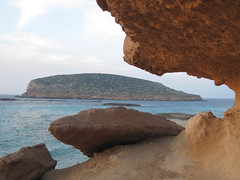
There are three beaches, lots of cliffs and interesting rock formations that glow deep orange in the evening sunlight, views of a host of islands, the defensive tower of "Torre D'en Rovira" and one of the finest pieces of graffiti art on the island at the southern bay near the nudist beach.

I have strong views about Cala Conta and believe that if you find yourself unable to take beautiful pictures here then you may as well just throw your camera in the sea and give up on photography altogether.

07 July 2011

Josep Lluís Sert's abandoned hotel at Cala D'en Serra.

Most touristy websites provide a view like this, with the hotel complex
carefully cropped out and no mention of it in the text either.
If you try a Google search for Cala D'en Serra in Ibiza the majority of the results will wax lyrical about the wonderful little beach in a cove north of Portinatx (like this example) but they will fail to mention the most striking feature of all; the huge abandoned building site looming over the beach like the gigantic corpse of some concrete predator that had died waiting for the tourist cash that never came.

I knew nothing about the place or it's history when I first ventured there on an exploration day in January 2011. We followed the signposts from the northern resort of Portinatx to Cala D'en Serra on a whim. When we arrived at the top of the cove the first thing my mate said was "bloody hell what's that?" I didn't know but I knew we'd have to go down and take a look.

The hotel complex as seen from above.
The cove is only accessible down a crumbling windy track so we left my car at the crest of the hill, fearing for it's already knackered track rods and suspension bushes and walked down to the cove, however many people choose to drive all the way down and park in the shade of the abandoned hotel. The half mile walk down to sea level provided some exceptional panoramic views over the bay and the abandoned hotel. Also around halfway down and off to the left are some impressive cliffs and traces of old stone buildings of some sort underneath the vegetation.

Once we got down to hotel itself, it was in an even worse state than it appeared from above. "PROHIBIDO PELIGRO" (Danger keep out) was written in faded white paint on one wall near the site enterance. Clearly no deterrent given the amount of grafitti and vandalism on the site. We had the cove entirely to ourselves for the afternoon and spent our time taking photos, kicking a football about, relaxing on the beach and pitching rocks into the sea.

When I got home I conducted some research and gathered that the hotel project was started in 1969 by acclaimed Catalan Architect Josep Lluís Sert who was exiled in the United States at the time. His clerk of works Antonio Ferran signed off on his projects back in Catalonia to get around the fact that Spain's fascist government ensured that Sert himself could not be accredited as an architect in the Catalonia & Balearic islands region. After a lot of work had already been completed the project was put on hold in the mid 1970s and abandoned completely after Sert died of lung cancer in 1983.

Trees growing through part
of the abandoned hotel structure.
Since Sert's death there have been many proposals and debates over what to do with his half finished project. Many people consider the half constructed hotel a blight on an area of outstanding natural beauty while others see the project as an important piece of cultural heritage given that Sert was one of Catalonia's most acclaimed architects (a list of his projects can be seen here). In the early 2000s plans were drawn up to complete the complex in the style intended by Sert for use as an exclusive tourist attraction and Thalassotherapy centre. These ambitious plans were eventually abandoned in the wake of the banking crisis and the subsequent downturn in the island tourist economy.

The site is now heavily overgrown with large trees growing through many of the structures. In other places it has been badly damaged by generations of vandals and by the passage of time. Several partition walls have been smashed through completely and parts of the superstructure have also been deliberately damaged. Exposure to the elements over time has caused much of the reinforced concrete to start splitting as the steel fibres within expand with rust causing the concrete to flake away.

One of the best preserved parts of the site is the terrace overlooking the bay which provides a phenomenal panoramic view of the cove and an interesting elevated view of the the small beach below. Even though the terrace is in relatively good condition, immediately behind it there is an abandoned swimming pool full of rubbish, rubble and a few inches of slimy green water at the deep end.

Some traditional style boat sheds are the only development
in the cove unrelated to the hotel complex.
The beach itself is relatively unaffected by the presence of the hotel and is a particularly picturesque location outside the summer tourist season, when, with luck visitors can have the beach entirely themselves. In the winter months the shallow waters of the bay remain fairly warm (warmer than the North Sea is at the height of summer). A wetsuit would be recommended for anyone not of the "hardy northern European type" intent on swimming there in the winter or early springtime.

For photographers there are some traditional Mediterranean boat sheds by the beach, a small beach garden, cliffs and beautiful turquoise waters. It is also possible to capture the striking contrast between the natural beauty of the beach and the decaying hulk of hotel above it.

The hotel complex is an excellent modern ruin for urbex photography, however be warned it is very unsafe for anyone without a basic knowledge of structural engineering to enter some parts of the site as several of the rooves and walkways have become structurally unsound.

This is one of my favourite images from the site. The abandoned car has
presumably been shoved down this hole to prevent tourists from falling down it.

18 May 2011

Sant Agustí

The church at San Agustín
Sant Agustí des Vedra is a picturesque rural village situated on a hilltop overlooking San Antonio bay only ten minutes drive from San Antonio city centre. The village is wonderfully unspoiled by modern influences which makes a refreshing change from the crowds and ubiquitous overdevelopment of the San Antonio bay area. The dominant feature of the village is the iglesia (church) in the centre of the village which was constructed between 1791 and 1809 under the direction of Pedro Grolliez de Servien.

The centre of the village also features an bar, a restaurant and a small convenience store but other than these unobtrusive developments the authentic rural atmosphere remains evident all around. A short walk further up the hill provides some spectacular views in both directions, back into the village and out across San Antonio bay.

The village provided refuge for the notorious Hungarian art forger Elmyr de Hory who fled mainland Europe in the 1960s and lived there until December 1976 when he committed suicide in his Sant Augustí villa upon hearing the news that the Spanish authorities had agreed to extradite him to France to face trial.


Cactus plan colonising a derelict outbuilding.
One of the most interesting locations in San Agustín for photography is a once impressive but now ruined villa and associated outbuildings around two minutes walk from the centre of the village. It is highly unusual to find rural decay in such a prime location as most of the islands ruins suffered abandonment as their location far from utilities such as electricity, running water supplies and telecommunications lines made development economically unviable. 

The San Agustín villa lies within easy access of all of the modern utilities but the owners have let it fall into ruin when a sale to developers at the peak of the Ibiza property market could have yielded many hundreds of thousands of Euros. I'm glad that for whatever reason the owners decided to avoid cashing in on their asset as the overgrown and decaying structures make fine photography subjects.

There are still a number of working farmsteads in the village and a small orange grove behind the church. Next to the village shop is a small track leading back down the hill towards the busy  PM-803 road. A walk along it reverals some impressive cactuses, collapsing terrace walls, an old well and some abandoned and rusting vehicles.


The village is definitely worth a visit whether for a relaxing afternoon in a quiet rural location followed by a meal at the Can Berri Vell restaurant or for a hardcore rural exploration photography treck around the local area.


An old horse drawn cart lies in a derelict and collapsing shed next to the main road into the village.